Faithful in Our Generation
We can tell the truth about our moment without making our suffering the center of the story.

Faithful in Our Generation
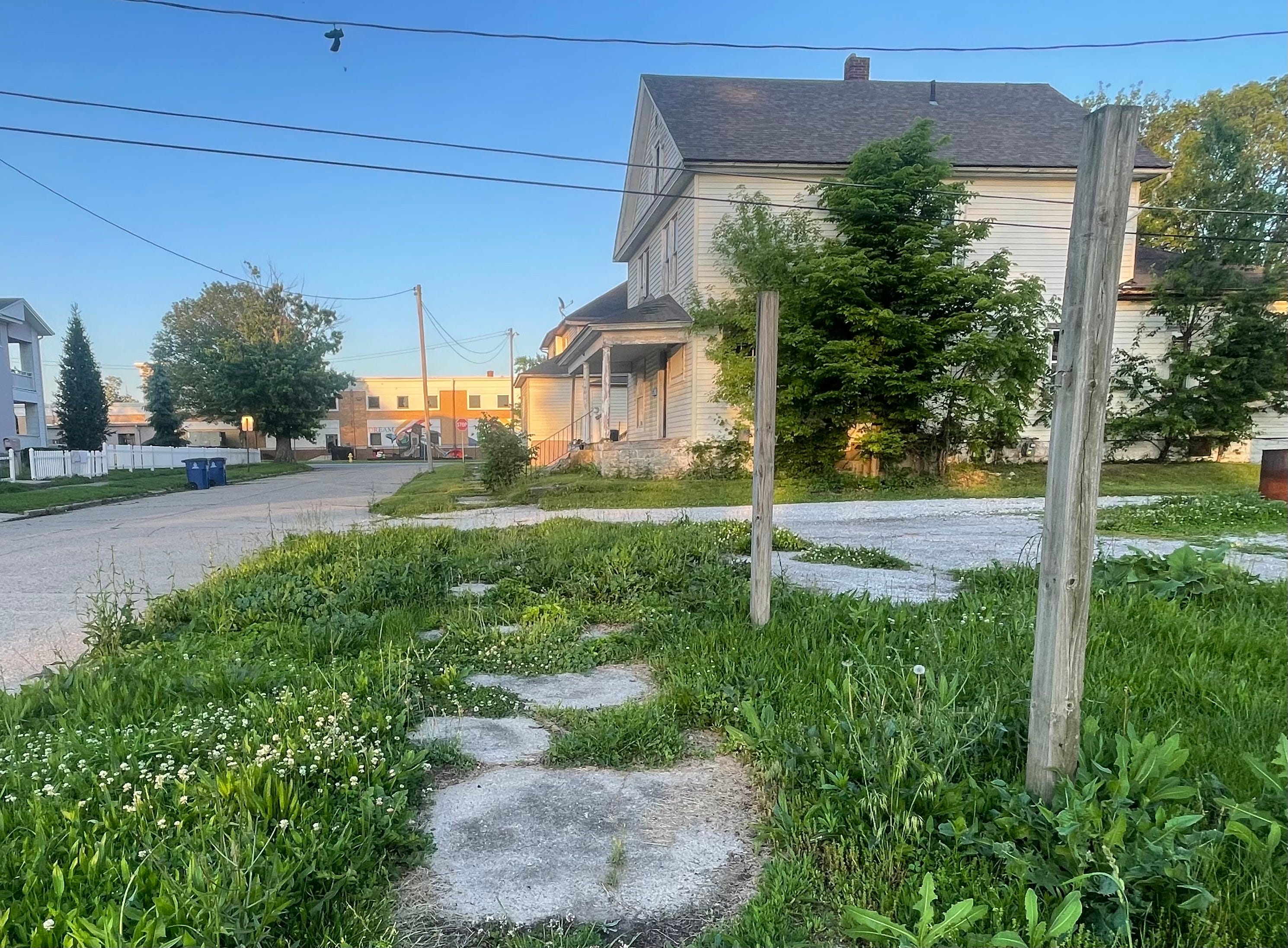
I often walk to the church from my house, and I pass this sidewalk along the way. It is uneven, overgrown, and broken in places, but it is still a path.
I also notice the house on the right. It has often sat abandoned. Then I look up and see the shoes hanging over the power line, and I wonder who put them there. Was it a joke? A memory? A sign of trouble? A child? A young man? A story I do not know?
Straight ahead is the building our church purchased for ten dollars in 2015 after a fire. It was once an elementary school in the 1950s. In the late 1980s, it was converted into the district offices for Marion Community Schools. We purchased it, started a church in 2016, and now that same building and property holds a Spanish language immersion preschool, a park, the local adult education program, and a countywide family resource center.
That is what life under the sun often feels like. You see broken sidewalks, abandoned houses, unanswered questions, and burned buildings. But if you keep walking, you may also see signs of resurrection.
Places that looked forgotten can still become places of witness, welcome, learning, play, and hope.
If we only focus on what is happening to us in the moment, we might miss the larger story God is telling. We might miss the more faithful witness right in front of us.
Every generation in human history has had to face the challenges of its own time.
Some generations have faced more than others. Some have faced devastation that is hard for us to even imagine. There are times when things seem to move forward. Then there are times when things seem to move backward. Sometimes the regression feels brand new, but in reality it is an old evil showing up with a new face. Other times, it may feel worse than anything before, even though history reminds us that suffering has always been part of life “under the sun.”
Solomon, the wisest and wealthiest king, looked at life under the sun and told the truth about it.
“I saw all the oppressions that are done under the sun. And behold, the tears of the oppressed, and they had no one to comfort them.”
Ecclesiastes 4:1
That is heavy.
But that does not mean God is absent.
It means we should not be shocked when the world acts like a world that is still groaning for redemption.
Paul said creation itself is groaning.
“We know that the whole creation has been groaning together in the pains of childbirth until now.”
Romans 8:22
That means the groaning is real. The oppression is real. The injustice is real. The grief is real.
But the groaning is not the end of the story.
All of human history is moving toward the new creation, where God will wipe away every tear and death will be no more.
“See, the home of God is among mortals… he will wipe every tear from their eyes. Death will be no more; mourning and crying and pain will be no more.”
Revelation 21:3–4
God has cared for every generation of human beings throughout history with the same love, justice, and mercy. There is nothing uniquely special about our time that makes our suffering more important than everyone else’s.
That is important for us to remember, especially in America.
There is oppression all over the globe right now. Our American exceptionalism can give us tunnel vision. It can make us think that we are unique, or that we are somehow the only country suffering. We can become so consumed with our own national crisis that we forget the groaning of our neighbors around the world.
In light of global injustice, many of us in America are still deeply privileged.
That is not to minimize our reality.
It is also not to idolize it.
We can tell the truth about what is happening here without making ourselves the center of human suffering. We can grieve injustice in our own land while also remembering the poor, the displaced, the persecuted, the colonized, the exploited, and the forgotten across the world.
This matters because suffering can become an idol too.
Our pain is real. Our grief is real. Our fear is real. The injustice around us is real. But if we are not careful, we can make our moment the center of the whole story. We can begin to act like no one has suffered like us, no generation has faced what we face, and no nation has carried the weight that we carry.
But Scripture will not let us stay that self-centered.
The Bible gives us a much bigger story.
It tells us about slavery in Egypt, exile in Babylon, empire in Rome, persecution in the early church, oppression of the poor, exploitation of the vulnerable, and the groaning of creation itself. The people of God have always had to learn how to be faithful in the middle of systems, empires, injustice, and suffering.
So the call is the same in every generation.
Remain faithful to God.
Tell the truth.
Do justice.
Love mercy.
Walk humbly.
Persevere.
Hope in the resurrection.
Follow Jesus.
“He has told you, O mortal, what is good; and what does the LORD require of you but to do justice, love mercy, and walk humbly with your God?”
Micah 6:8
“Here is a call for the endurance and faithfulness of the saints.”
Revelation 13:10
I wonder if part of our struggle in America is that our privilege has jaded us.
We have become so accustomed to comfort, security, influence, and control that we are having a hard time knowing how to suffer faithfully in the current moment.
But faithfulness was never dependent on comfort.
The saints before us endured slavery, exile, empire, poverty, persecution, war, displacement, and death. Many of them did not see deliverance in their lifetime, but they remained faithful.
Hebrews tells us that some conquered kingdoms and received promises, while others were tortured, imprisoned, mistreated, and wandered in deserts, mountains, caves, and holes in the ground. Yet they lived by faith.
“All of these, though they were commended for their faith, did not receive what was promised.”
Hebrews 11:39
That is sobering.
Some people are faithful and see breakthrough.
Some people are faithful and die waiting.
Some people are faithful and watch things get better.
Some people are faithful while things seem to get worse.
But the measure of faithfulness is not whether history bends according to our preferred timeline. The measure of faithfulness is whether we keep trusting God, loving our neighbors, telling the truth, doing justice, and following Jesus when the world around us is shaking.
Our task is not to panic as if God has lost control.
Our task is not to pretend that our suffering does not matter.
Our task is also not to make our suffering ultimate.
Our task is to be found faithful in our generation, trusting that the God who has carried his people through every age will carry us too, until all things are made new.
Reflection Questions
Where has my American privilege shaped the way I interpret suffering, injustice, comfort, and security?
Am I grieving injustice in my own country while still remembering the suffering of my neighbors around the world?
How can I tell the truth about what is happening without minimizing it or idolizing it?
What would it look like for me to resist panic, despair, and self-righteousness in this moment?
What does faithfulness look like on the actual streets I walk, among the actual people God has placed in front of me?